What actually happens on the day your roof is replaced
Most homes are one to two days. Here is what those days look like.
September 17, 2026 · 3 min read
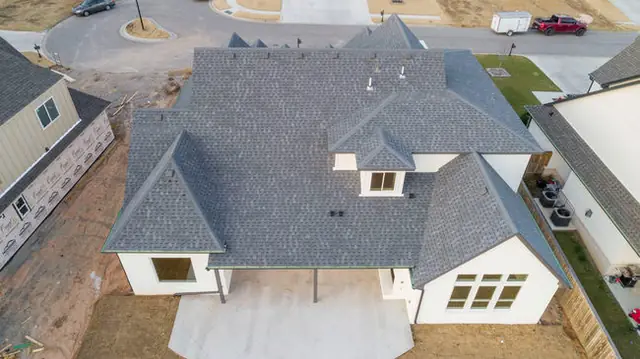
Having a roof replaced is one of the larger things that will happen to your house, and for most people it happens once or twice in the entire time they own it. So it is reasonable not to know what the day looks like. Here is the sequence.
Before anyone arrives
You should have the schedule before the day itself. One of the things customers tell us matters most is simply knowing when people are turning up, and one of the things that annoys people most about contractors generally is finding out by hearing a truck.
Practically, it helps to move vehicles off the drive, take anything fragile off the walls in upstairs rooms because a tear off is percussive, and if you have pets that startle easily, plan for them to be somewhere else. Garden furniture and grills directly under the eaves are worth moving too.
The tear off
Crews usually start early, and the first phase is the loudest. The existing roof comes off down to the deck. This is not just demolition, it is the only moment in the life of the roof when anyone can actually see the structure underneath, which is why we do it rather than laying new material over the old.
Old material goes straight into a dumpster or a truck rather than accumulating on the lawn, and the crew clears debris as they work rather than leaving it all to the end.
Reading the decking
With the roof stripped, the deck gets inspected properly. Soft or rotten sheathing gets replaced. Damaged rafters get repaired. This is the point at which a job can change slightly in scope, and it is the point at which you want a contractor who will call you rather than quietly cover it up.
It is worth saying plainly: nobody can tell you with certainty what is under your roof before the roof comes off. A contractor who guarantees there will be no deck work is guessing.
Underlayment and flashing
Underlayment goes down as the secondary water barrier, and this is where the detailing around valleys, penetrations and edges gets done. Flashing at valleys and around anything that comes through the roof is where most future leaks are either prevented or created, so it is worth more attention than it usually gets.
The shingle field and the ridge cap
Shingles work up the slope in courses. Ventilation gets corrected on the way, because a roof that cannot breathe will shorten the life of the work you have just paid for. The ridge cap goes on last, sealing the highest line on the roof.
By this stage the noise has dropped considerably and the job starts visibly becoming a roof again.
Cleanup, which is not optional
A tear off throws thousands of old nails into the grass, the beds and the driveway. Clearing them is part of the job, not a courtesy, because you will be walking on that grass and parking on that drive long after the crew has gone.
The crew clears debris and runs magnets over the drive and the yard before the job is called finished. On some of ours, somebody comes back after the crew has left specifically to check the yard again. One customer wrote that her sales associate came out after the work was completed purely to make sure the yard was free of nails.
It is a small thing, and it is the detail our customers mention more often than any other, which probably tells you how often it gets skipped elsewhere.
How long it really takes
Most homes are one to two days. One of our crews started at first light and had a full roof finished by half past six the same evening, cleanup included. A larger or more complex roof, or one that needs significant deck replacement, will run longer.
Weather obviously drives this. No responsible contractor will strip a roof into an incoming front, and a schedule that ignores the forecast is a schedule that ends with your house open in the rain.
Afterwards
Expect somebody to come back and look at the finished job rather than simply invoicing you. Our owner, Ben Moore, does this himself, and customers write about it: one described the arc from the estimate through to final payment, with Ben coming by the next day to check the job over.
If you want to talk through what your roof would involve, call (918) 508-1771. Estimates are free.
Driller Roofing & Construction, (918) 508-1771
Call (918) 508-1771More articles
Should you file an insurance claim after an Oklahoma hail storm?
The honest answer is not always, and knowing why will save you a claim you did not need to make.
What actually fails first on a Tulsa roof
Six places worth checking, and why none of them are visible from the ground.